Supernova: The Explosive Death of Stars
Introduction
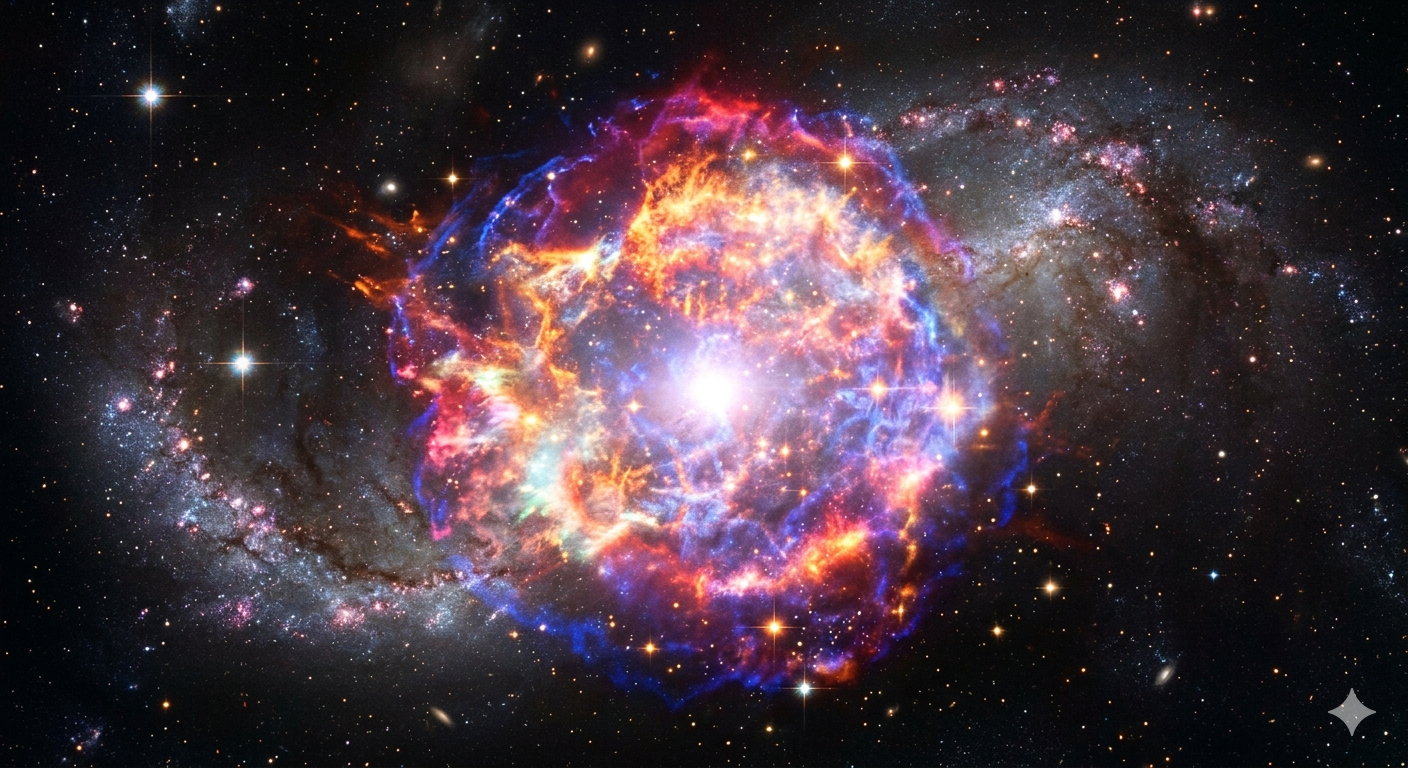
A supernova is one of the most powerful and energetic events in the universe. It marks the violent death of a star, releasing enormous amounts of energy in a short period—sometimes outshining entire galaxies.
Supernovae are not just spectacular cosmic events; they play a crucial role in:
- Creating heavy elements (like iron, gold, uranium)
- Driving galaxy evolution
- Seeding the universe with the building blocks of planets and life
In this blog, we explore the physics, types, and recent groundbreaking discoveries (2025–2026) in supernova research.
What is a Supernova?
A supernova occurs when a star reaches the end of its life and undergoes a catastrophic explosion.
The energy released can be:
\[ E \sim 10^{44} \text{ Joules}\]
This is equivalent to the energy our Sun will emit over its entire lifetime.
Types of Supernovae
Supernovae are broadly classified into two main categories:
1. Type I Supernova (Thermonuclear Explosion)
These occur in binary star systems involving a white dwarf.
Mechanism:
- A white dwarf accretes matter from a companion star
- When it reaches the Chandrasekhar limit (~1.4 solar masses)
- It undergoes a runaway nuclear explosion
Key Features:
- No hydrogen lines in spectrum
- Extremely consistent brightness
- Used as standard candles in cosmology
2. Type II Supernova (Core-Collapse)
These occur in massive stars (> 8 solar masses).
Mechanism:
- Nuclear fusion stops
- Core collapses under gravity
- Shockwave ejects outer layers
Remnants:
- Neutron star
- Black hole
Physics Behind Supernova Explosion
Core Collapse Process
When fusion stops:
\[ P_{\text{thermal}} < P_{\text{gravity}}\]
The core collapses rapidly:
- Electrons combine with protons → Neutrons
- Neutrinos are released
- Shockwave forms
Energy Distribution
- 99% → Neutrinos
- 1% → Explosion energy
- Tiny fraction → Visible light
Light Curve of a Supernova
A typical light curve shows:
- Rapid rise in brightness
- Peak luminosity
- Gradual decay due to radioactive decay
\[ ^{56}Ni \rightarrow ^{56}Co \rightarrow ^{56}Fe\]
Latest Discoveries (2025–2026)
Modern astronomy has entered a golden era of supernova discovery, driven by AI, space telescopes, and large surveys.
1. First Gamma-Ray Detection from Superluminous Supernova
A recent study detected gamma rays from a superluminous supernova, confirming that some explosions are powered by magnetars (highly magnetic neutron stars).
- Magnetars can spin hundreds of times per second
- Their energy powers extremely bright explosions
- Helps explain “superluminous supernovae”
2. Earliest Stages of Supernova Observed
Astronomers observed a supernova just 26 hours after explosion, revealing:
- Explosion is not perfectly spherical
- Presence of surrounding gas disks
-
New insights into stellar death dynamics
3. Supernova in the Early Universe (JWST Breakthrough)
The James Webb Space Telescope detected a supernova from:
- Only ~730 million years after the Big Bang
This shows:
- Early stars exploded similarly to modern stars
- Massive star evolution began very early
4. Most Distant Supernova Ever Observed
A record-breaking discovery:
- Supernova SN Eos
- Distance: ~26 billion light-years
- Observed via gravitational lensing
This provides insight into:
- Early universe conditions
- Low-metallicity star evolution
5. Discovery of a New Type of Supernova (AI-Assisted)
Astronomers discovered a new class:
- Explosion triggered by a black hole companion
- Star stripped and exploded due to interaction
- Detected using AI-based analysis
This challenges traditional models of stellar death.
6. Explosion Observed in Real-Time by Citizen Scientists
Citizen science platforms helped detect:
- Extremely bright transient events
- Rapid identification of rare stellar explosions
7. Massive Increase in Supernova Detection Rate
The Vera Rubin Observatory is transforming astronomy:
- Hundreds of thousands of transient alerts per night
- Millions expected in future surveys
This will:
- Enable real-time supernova tracking
- Improve statistical understanding
Supernova and Element Formation
Supernovae are responsible for creating heavy elements:
| Element | Origin |
|---|---|
| Iron | Core-collapse |
| Gold | Explosive nucleosynthesis |
| Uranium | Extreme supernovae |
Without supernovae:
Planets and life as we know them would not exist.
Supernova Remnants
After the explosion, we observe:
- Expanding gas clouds
- Shockwaves interacting with interstellar medium
- High-energy radiation
Famous examples:
- Crab Nebula
- Cassiopeia A
Applications in Science
Supernovae are critical tools in astrophysics:
- Measuring cosmic distances
- Studying dark energy
- Understanding stellar evolution
- Probing galaxy formation
Challenges in Supernova Research
Despite progress, many mysteries remain:
- What triggers asymmetry in explosions?
- Exact mechanism of core-collapse shock revival
- Role of magnetic fields and rotation
- Formation pathways of black holes
Future of Supernova Research
Upcoming missions and tools:
- James Webb Space Telescope (JWST)
- Vera Rubin Observatory (LSST)
- AI-driven sky surveys
Expected breakthroughs:
- Early detection of explosions
- Better explosion models
- Discovery of entirely new classes
Conclusion
Supernovae are among the most fascinating and important phenomena in the universe.
From:
- Exploding stars
- Creation of heavy elements
- Expansion of the universe
to:
- AI-driven discoveries
- Observations from the early universe
we are entering a new era of understanding cosmic explosions.